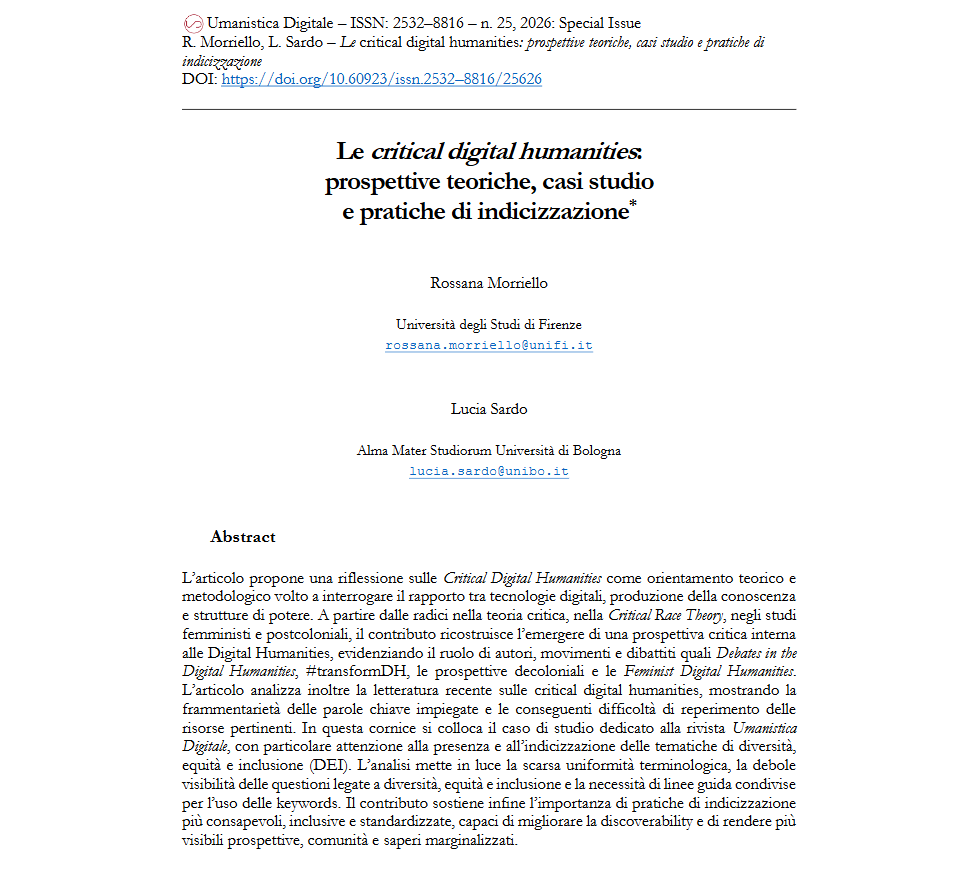
“Le critical digital humanities: prospettive teoriche, casi studio e pratiche di indicizzazione”, scritto a quattro mani con Lucia Sardo, è appena uscito sull’ultimo numero della rivista “Umanistica Digitale”, in open access. https://umanisticadigitale.unibo.it/index
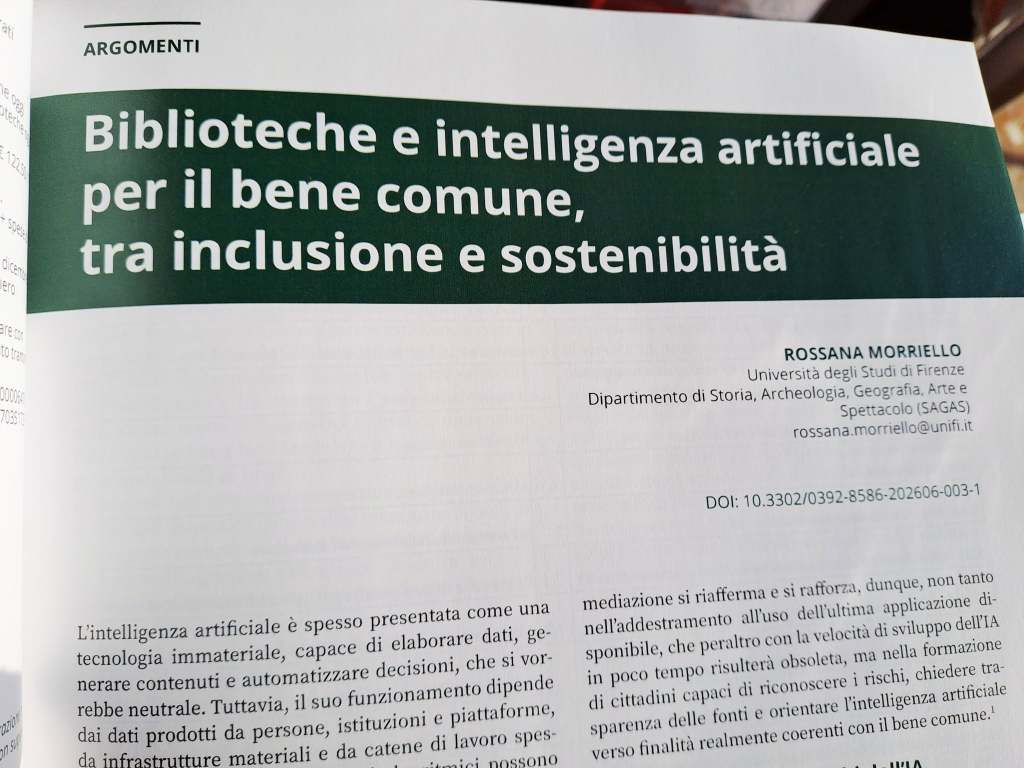
This paper examines the relationship between libraries, artificial intelligence and the common good from the perspectives of inclusion, sustainability and social responsibility. Moving from the MIT AI Risk Repository, it focuses on three areas of risk that are especially relevant to information professions: discrimination and toxicity, misinformation and disinformation, and socioeconomic and environmental harms. The paper shows how AI systems may reproduce and amplify existing inequalities, particularly gender and intersectional biases, while also contributing to the degradation of information ecosystems through misleading, decontextualized or manipulated content. It further highlights the material and social infrastructures behind AI, including the invisible labour of data workers and the growing environmental impact of data centers. Against this background, libraries are presented not merely as points of access to new technologies, but as spaces of critical mediation, public education and democratic accountability. The paper argues that AI literacy should be understood as an expanded dimension of information literacy, capable of integrating ethical, social, ecological and political awareness. Only by recognizing both the potential and the risks of AI can libraries help orient algorithmic systems toward inclusive, sustainable and genuinely common-good objectives.
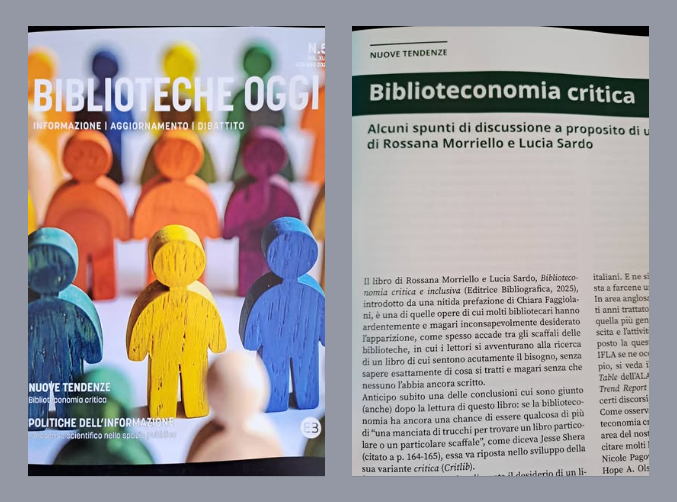
Il numero di luglio-agosto della rivista scientifica Biblioteche oggi contiene un articolo-recensione del libro scritto con Lucia Sardo “Biblioteconomia critica e inclusiva”. L’articolo molto bello, firmato da Luca Ferrieri, riesce a cogliere perfettamente lo scopo e il senso del libro, la necessità e l’urgenza di affrontarne le tematiche che proponiamo e al tempo stesso aggiunge spunti di riflessione e di approfondimento. E poi quell’incipit per chi scrive è il migliore riconoscimento che si possa ricevere per il lavoro svolto.
Negli ultimi anni la biblioteconomia ha iniziato a interrogarsi con sempre maggiore consapevolezza sul proprio ruolo sociale, sulle forme di esclusione che può riprodurre senza accorgersene e sulle pratiche che invece possono renderla uno spazio realmente aperto, equo e trasformativo. Questo libro nasce proprio da questa prospettiva: esplorare cosa significhi oggi parlare di biblioteconomia critica e inclusiva, quali strumenti teorici e operativi abbiamo a disposizione e come le biblioteche possano diventare luoghi di partecipazione, rappresentazione e giustizia sociale.
Pubblicato il programma dell’annuale Convegno delle Stelline. Giovedì 30 marzo dalle 14.30 alle 18 in Sala Porta si terrà la sessione dal titolo Per un’altra biblioteconomia: diversificare e decolonizzare la biblioteca, organizzata dal gruppo di lavoro coordinato insieme a Lucia Sardo. Al convegno presenterò una relazione a quattro mani dal titolo Biblioteconomia e decolonialità: collezioni e cataloghi per una visione altra.
Il focus del gruppo di lavoro sarà la biblioteconomia critica, discussa mediante la presentazione di alcune possibili declinazioni della disciplina e delle ricadute in termini di identità della biblioteca e di nuovi paradigmi.
Critical librarianship places librarianship in an active position in society. Critical librarians strive to reduce library practices that might reinforce, consciously or unconsciously, systems of oppression in society. One aspect is decolonization. This means avoiding practices that can reinforce a colonial approach, that is discrimination according to race, ethnicity, gender, and removing all barriers towards an equitable access to information. The article firstly defines the concept of decolonization, from the writings of Aimé Césaire, then it applies it to libraries, recalling the work of UNESCO in the 70’s to solve “the book hunger” in the Global South and getting to UN Agenda 2030. Data about the contemporary book market are included as examples of issues in collection development.